
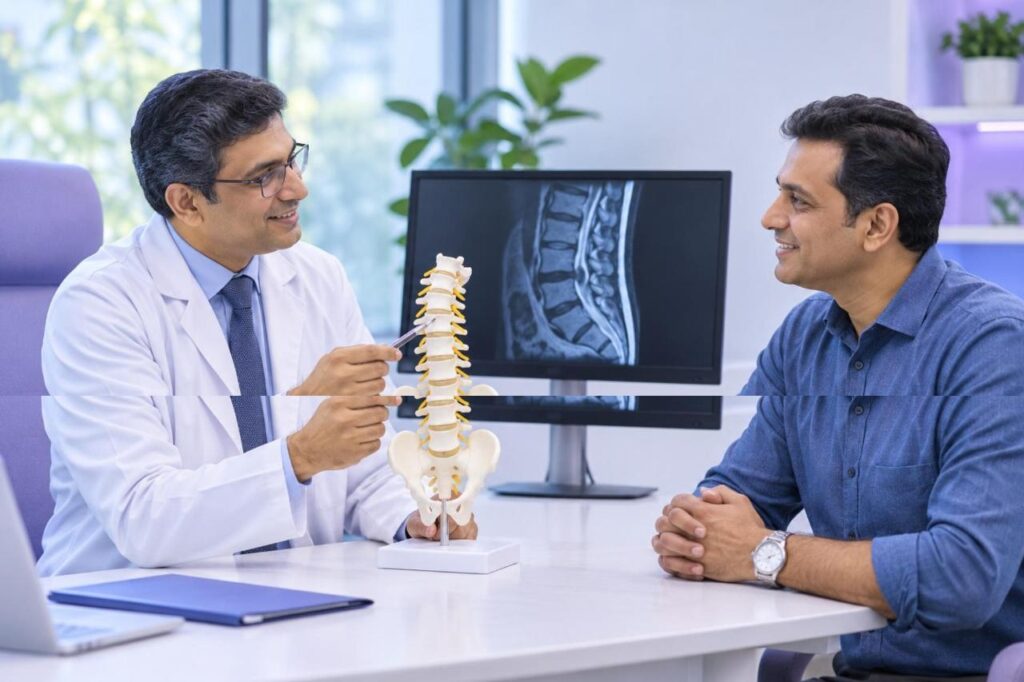
A second opinion for spine surgery means asking another spine specialist, usually a neurosurgeon or an orthopaedic spine surgeon, to review your MRI, your symptoms and the operation you have been advised before you decide. It is most useful for planned operations such as disc surgery, decompression for spinal stenosis or spinal fusion. It is not for emergencies. Sudden loss of bladder or bowel control, numbness around the genitals or back passage, or leg weakness that is getting worse needs hospital care straight away.
Below you’ll find the common situations, the warning signs that can’t wait, what a specialist reviews, the questions to ask and how to prepare.
Key takeaways
- Bladder or bowel problems, numbness in the saddle area or worsening leg weakness with back pain are emergencies. Go to hospital first.
- For many slipped discs and cases of sciatica, non-surgical care is usually tried first, and many people improve with time.
- MRI changes such as disc bulges are very common in people with no pain. What matters is whether the scan matches your symptoms and examination.
- Spinal fusion is permanent, so it deserves a careful second look, especially when it is advised for back pain alone.
- Share the actual MRI images, not just the report, along with a clear timeline of your symptoms and treatments.
First: warning signs that need urgent care
Some back problems can’t wait for a second opinion. Call 108 or go to the nearest hospital emergency department if you have back pain or sciatica with any of these:
- Loss of control of your bladder or bowels, or being unable to pass urine
- Numbness around your bottom, genitals or inner thighs
- Sciatica in both legs
- Weakness or numbness in one or both legs that is severe or getting worse
- Back pain after a serious accident or fall
These can be signs of cauda equina syndrome, where the bundle of nerves at the bottom of the spine is squeezed. Cleveland Clinic describes it as a medical emergency that often needs surgery quickly. Don’t drive yourself to hospital. A second opinion can help later with longer-term decisions.
Common situations where a second opinion helps
Slipped disc (disc herniation)
A slipped disc happens when the soft centre of a spinal disc pushes out and presses on a nerve. The NHS says surgery is not usually needed, and that a slipped disc usually gets better slowly with rest, gentle exercise and painkillers. The American Academy of Orthopaedic Surgeons (AAOS) says spine surgery is typically recommended only after a period of non-surgical treatment has not relieved painful symptoms. Surgeons may operate sooner for muscle weakness, difficulty walking, or loss of bladder or bowel control.
Sciatica
Sciatica is pain that travels from the lower back down the leg, often caused by a disc pressing on a nerve root. The NHS notes it usually gets better in a few weeks to a few months, but can last longer. When pain is severe and treatment hasn’t helped, decompression surgery can sometimes help. The UK’s National Institute for Health and Care Excellence (NICE) suggests considering spinal decompression for sciatica when non-surgical treatment has not improved pain or function and the scan findings match the symptoms.
Spinal stenosis
Spinal stenosis is a narrowing of the space inside the spine. Mayo Clinic explains that in the lower back it can cause pain or cramping in one or both legs, which often gets better when you bend forward or sit. In many people, though, spinal stenosis doesn’t cause any symptoms. So the decision usually depends on how far you can walk, how much your daily life is affected and whether your symptoms fit the narrowing seen on the scan.
Advice to have spinal fusion
Spinal fusion joins two or more vertebrae into one solid bone. AAOS lists conditions where it may be used, including spondylolisthesis (a slipped vertebra), fractures, scoliosis, infection and tumours. It also notes that surgery is usually recommended only when the doctor can identify the source of the pain.
For low back pain on its own, NICE advises against spinal fusion except as part of a research trial. That advice is about back pain without a specific cause. It doesn’t cover problems such as a fracture, infection or tumour. But if you have been advised fusion mainly for back pain, or fusion at several levels, a second opinion is especially worthwhile. Fusion can’t be undone, and AAOS notes it may take several months for the bone to become solid.
When surgery is clearly needed, and when other care usually comes first
Surgery is often the right choice, and sometimes it is urgent. Your specialist may advise operating soon if you have cauda equina symptoms, significant or worsening weakness, pressure on the spinal cord, a fracture, an infection or a tumour.
For many other people, non-surgical care is tried first. NICE guidance on low back pain and sciatica includes exercise programmes, manual therapy as part of an exercise-based package, psychological support using a cognitive behavioural approach, carefully chosen medicines, and, for acute and severe sciatica, epidural steroid injections in some cases. Your doctor will decide which of these suit you.
Neither path is automatically better. Some people improve without an operation, while others get faster relief from surgery. A second opinion helps you understand what you gain or risk by waiting.
Advised disc surgery, decompression or spinal fusion? A verified spine super-specialist can review your MRI and reports before you decide.
What a spine super-specialist reviews
- MRI images: which level is affected, how much a nerve or the spinal cord is compressed, and whether the findings explain your pain.
- X-rays: alignment, slips and, when bending (flexion-extension) views are taken, whether part of the spine moves abnormally.
- CT scans, if done, for detail of the bones.
- Nerve tests such as EMG or nerve conduction studies, which can help when it is unclear whether symptoms come from the spine or from nerves elsewhere, for example in diabetes.
- Your symptoms and examination: where the pain is (back or leg), numbness, weakness, reflexes and walking distance.
Symptoms vs imaging
This is often the most important part of the review. A 2015 systematic review in the American Journal of Neuroradiology found that signs of disc degeneration were present in 37% of people aged 20 with no back pain, rising to 96% at age 80. Disc bulges were seen in 30% of pain-free 20-year-olds and 84% of 80-year-olds. The authors concluded that many of these changes are likely part of normal ageing.
So the key question isn’t “Is there something on my MRI?” It is “Does what’s on my MRI explain my symptoms?”
Questions to ask in a second opinion for spine surgery
- Do my MRI findings match my symptoms and examination?
- Is this operation urgent, or is there time to try other treatment first?
- What exactly will be done, at how many levels, and would decompression alone be enough instead of fusion?
- Is a less invasive approach suitable for me?
- What is the operation most likely to improve: leg pain, back pain, weakness or walking distance?
- What are the risks for someone with my age, health and medicines?
- How long is recovery, and when can I return to work, drive or travel?
- What happens if I wait, and which symptoms would mean I shouldn’t wait?
How to prepare your reports
Keep these ready:
- MRI images on CD/DVD or a download link, plus the written report. Older scans help for comparison.
- X-rays, including any standing or bending views, and CT scans if done
- Nerve test reports (EMG or nerve conduction studies), if any
- The surgeon’s written advice, with the name of the operation and the spinal levels
- A list of treatments tried, such as physiotherapy, medicines or injections, and how long each was tried
- A one-page symptom timeline: when it started, back pain vs leg pain, numbness, weakness and how far you can walk
- Current medicines and other conditions, such as diabetes or heart disease
- The hospital’s cost estimate, with implants such as screws and rods listed separately, and your insurance or TPA details
India’s Charter of Patients’ Rights lists your right to seek a second opinion and to get copies of your case papers and investigation reports. For a general checklist, see our guide to a second opinion before surgery.
Family, travel and insurance
Spine decisions are often family decisions, and many families travel to a metro city to see a specialist. An online review first can help you decide whether that trip is needed.
Planned spine surgery under a cashless policy usually needs pre-authorisation from your insurer or TPA. Some policies have waiting periods for certain planned operations. Check your policy wording and ask the hospital’s insurance desk which documents they need, so the second opinion doesn’t hold up your paperwork.
How a DoctorNika second opinion works
- Tell us about your case and what has been advised.
- Get matched with a verified spine super-specialist, or choose one from our panel.
- Pay securely online and share your MRI, X-rays and reports through a secure link.
- Receive a written opinion covering your diagnosis, treatment options including non-surgical ones where relevant, and questions to discuss with your treating doctor. With a video consultation, your family can ask questions directly.
Then take the opinion back to your surgeon. The aim is to support your treating doctor and help you make a well-informed decision together, not to replace them. Don’t cancel or change planned treatment on your own. To learn more, read what a medical second opinion is, or our guide to a second opinion for knee replacement.
Get clarity before spine surgery. Upload your scans securely, pay online, and receive a written opinion or video consultation from a verified super-specialist. See how it works.
Frequently asked questions
Does a slipped disc always need surgery?
No. Many people improve with time and non-surgical treatment. Surgery is usually considered when symptoms don’t improve, or sooner if there is significant weakness or bladder or bowel problems. Your specialist will advise based on your case.
My MRI shows several disc bulges. Do I need an operation?
Not necessarily. Disc bulges are common even in people without back pain, and become more common with age. What matters is whether the findings match your symptoms and examination.
I have back pain and bladder or bowel problems. Should I get a second opinion first?
No. Treat it as an emergency. Call 108 or go to the nearest hospital straight away. A second opinion can come later, once you have been assessed and treated.
Can a second opinion for spine surgery be done online?
Yes, in many cases. With your MRI images, X-rays, nerve test reports and a clear symptom history, a specialist can review your case remotely and give a written opinion or a video consultation. They may advise an in-person examination if needed.
Will my insurance pay for a second opinion before spine surgery?
It depends on your policy. Some include a second-opinion benefit and others don’t. Check your policy wording, or ask your insurer or TPA.
Sources
- NHS – Slipped disc
- NHS – Sciatica
- AAOS OrthoInfo – Herniated disk in the lower back
- AAOS OrthoInfo – Spinal fusion
- Mayo Clinic – Spinal stenosis: symptoms and causes
- Cleveland Clinic – Cauda equina syndrome
- NICE – Low back pain and sciatica in over 16s: assessment and management (NG59)
- American Journal of Neuroradiology – Systematic literature review of imaging features of spinal degeneration in asymptomatic populations (Brinjikji et al., 2015)
- National Council for Clinical Establishments, MoHFW – Charter of Patients’ Rights and Responsibilities
This article is for general information and is not a substitute for advice from your own doctor. In an emergency, call 108 or go to the nearest hospital — do not delay emergency treatment to get a second opinion.

Our guides are written to help patients and families understand their options. They are general information, not personal medical advice.