
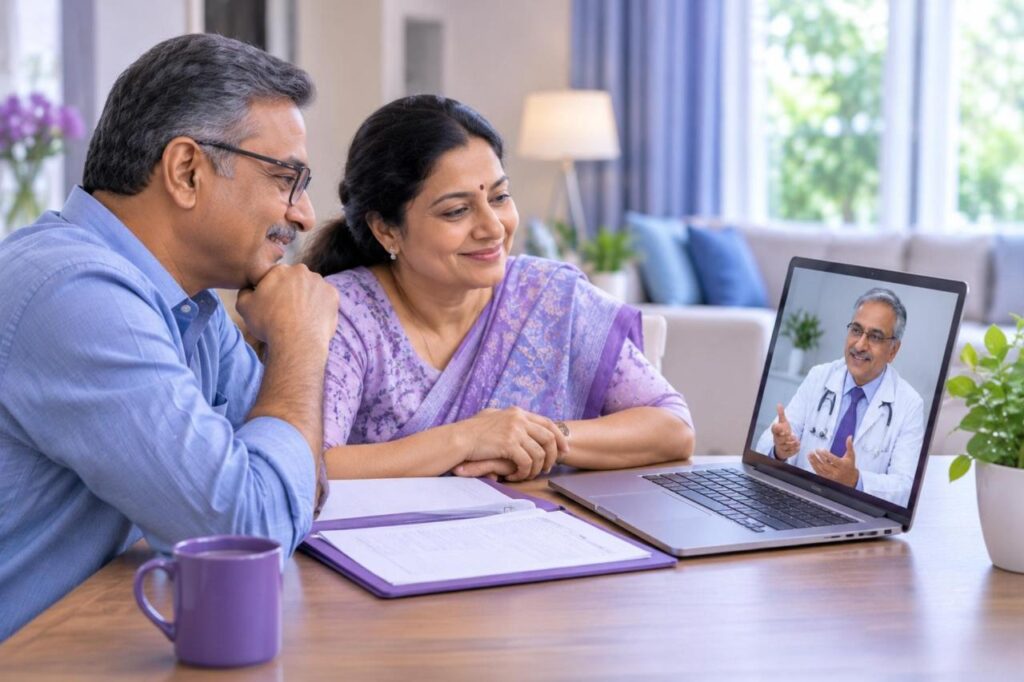
An online second opinion is when a specialist who is not treating you reviews your reports, scan images and treatment plan remotely, then gives you a written opinion and, if you want one, a video consultation. It works well when a decision depends mainly on tests, scans and biopsy results. It can save your family a long trip to a metro city, but it does not replace an in-person examination when one is needed.
This guide explains how an online second opinion works in India, what can and cannot be reviewed remotely, what the rules say about telemedicine and privacy, and how to get your documents ready.
Key takeaways
- An online second opinion is an independent, remote review of your existing reports, scans and treatment plan by a specialist.
- The most useful reviews include the actual scan images, not just the written reports.
- Many decisions can be reviewed online, but some need a doctor to examine you in person. A good specialist will tell you when that applies.
- India’s Telemedicine Practice Guidelines 2020 allow registered doctors to consult remotely, with rules on identity, consent and records.
- Online reviews are for planned decisions. In an emergency, call 108 or go to the nearest hospital.
What is an online second opinion?
It is the same idea as any medical second opinion: a fresh, independent look at your diagnosis and treatment plan. The only difference is that the specialist reviews your records through a secure online system instead of in a clinic.
For many Indian families, that difference matters. The nearest super-specialist may be a long, costly journey away, and travelling with someone who is unwell, finding a place to stay and taking leave from work all add up. An online review lets the family hear an expert view first, and travel only if it is really needed.
The second doctor reviews and advises. Your treating doctor stays in charge of your care.
How an online second opinion works, step by step
- Share the basic details. Tell the service the diagnosis, what has been advised and what decision you are facing, so the case goes to the right super-specialist.
- Collect the records. Use the checklist below.
- Upload them securely. Photograph or scan paper reports clearly. Share scan images in their original digital form, from the CD, DVD or download link.
- The specialist reviews the case. They may ask questions, or suggest a missing test before giving a firm view.
- You receive a written opinion. A good report says whether the specialist agrees with the diagnosis and plan, mentions other reasonable options, and lists points to discuss with your treating doctor.
- Talk it through on video. The patient and family can ask questions directly, and relatives in other cities can join the same call.
- Go back to your treating doctor and decide the next step together.
Why scan images matter, not just reports
A CT, MRI or PET-CT report is one doctor’s summary of what they saw. The second specialist often wants to see the pictures too. Hospitals store and share them using DICOM, the international standard for medical imaging information. With the original files, rather than photos of the film, the specialist can scroll through every image, zoom in and measure. The same applies to an angiography video, as our guide to a second opinion for heart surgery explains.
Advised a major treatment, and the right specialist is far away? Share your reports and scans securely and get a written opinion from a verified super-specialist, without travelling.
What can be reviewed online, and what needs an in-person visit
Telemedicine has one clear limit: the doctor cannot examine you in person. Mayo Clinic notes that this can affect a diagnosis. India’s telemedicine guidelines say that if a physical examination is critical, the doctor should not go ahead until one can be arranged in person.
Usually suitable for online review
- Decisions that depend on scans, such as CT, MRI, PET-CT or angiography
- Biopsy and pathology reports (slides may need to be couriered for a full review)
- Cancer treatment plans. See our guide to a second opinion for cancer.
- Advice about planned surgery or procedures
- Long-term conditions where the question is whether the current treatment is right
- The records of a loved one in intensive care, reviewed alongside the ICU team. Read our guide to a second opinion for ICU patients.
When an in-person examination may be needed
- When the diagnosis depends on what a doctor feels, hears or sees during an examination
- When key tests are missing, unclear or too old to rely on
- When symptoms have changed a lot since the last tests
- When the specialist needs to do a test or procedure themselves
A good online specialist will say so honestly. Being told you need an in-person visit is useful advice in itself.
India’s telemedicine rules in plain English
India’s Telemedicine Practice Guidelines were issued in March 2020 by the Board of Governors then in charge of the Medical Council of India, prepared with NITI Aayog. They form part of the professional conduct regulations for doctors. In general terms, they say:
- Only a registered medical practitioner can consult. AI tools and other software may not counsel patients or prescribe medicines.
- Consultations shouldn’t be anonymous. The doctor confirms who the patient is, and the doctor’s name, qualifications and registration number should be clear.
- The doctor uses professional judgement to decide whether an online consultation is enough.
- Consent matters. If the patient starts the consultation, consent is implied. If someone else, such as a caregiver, starts it, the doctor needs explicit consent and must record it.
- Records must be kept, as they would be for a clinic visit, and some medicines can’t be prescribed remotely.
- Not for emergencies. Telemedicine should be avoided for emergency care when in-person care is available.
That last point matters most. An online review is for planned decisions, not emergencies.
Privacy and consent: keeping your reports safe
Medical reports are among the most personal papers a family has. India’s Charter of Patients’ Rights and Responsibilities lists the right to confidentiality, human dignity and privacy during treatment. The ethics regulations for doctors also say patient information must be kept confidential, apart from narrow exceptions set out in law.
India’s Digital Personal Data Protection Act, 2023 is built around notice and consent. It describes rights such as asking how your data is used, correcting it and withdrawing consent, and expects organisations to keep reasonable security safeguards.
A few practical habits help:
- Share reports through the service’s secure upload, not in large family WhatsApp groups.
- Ask who will see your reports, and whether they will ever be used for any other purpose.
- If you are sharing on behalf of an adult patient, involve them and get their agreement whenever they are able to give it.
How to prepare your documents
Complete records lead to a faster, more useful opinion. Keep these ready:
- Discharge summaries from every relevant hospital stay
- Consultation notes and the written treatment plan or surgery advice
- Scan reports and images: CT, MRI, PET-CT, ultrasound, X-ray or angiography, on CD/DVD or as a download link
- Biopsy and pathology reports, including any special tissue tests
- Blood tests, both the latest and older ones for comparison
- Operation notes from any earlier surgery
- A current medicine list, with doses and any allergies
- A short note of symptoms: what started when, and what has changed
Scans on a CD or DVD
Many laptops no longer have a disc drive, so ask the radiology department for a download link. If that isn’t possible, a computer shop or diagnostic centre can usually copy the whole disc to a pen drive. Copy everything, not just a few screenshots.
Asking the hospital for copies
India’s Charter of Patients’ Rights lists your right to copies of case papers, patient records and investigation reports. Under the Indian Medical Council regulations of 2002, records requested by a patient or authorised attendant should be issued within 72 hours.
If your hospital is connected to the Ayushman Bharat Digital Mission, you may also be able to link records to your ABHA app and share them with your consent.
Questions to ask in an online second opinion
- Do you agree with the diagnosis? Is anything missing or unclear in my reports?
- Do you agree with the treatment plan? Are there other reasonable options?
- Is there anything you couldn’t judge without examining me in person?
- Do I need another test before deciding? Can it be done in my city?
- How urgent is this decision? How much time can I safely take?
- What should I discuss with my treating doctor?
- Can my family join the video call, and can we talk in a language we’re comfortable with?
How DoctorNika works
DoctorNika connects patients with verified super-specialists, doctors with DM, MCh or equivalent training, for a written second opinion and a video consultation.
- Book your case and tell us what has been advised.
- A care coordinator contacts you on WhatsApp to confirm the specialist and the fee, and to explain how to share your reports securely.
- The super-specialist reviews your records and sends a signed written opinion.
- If you choose a video consult, the patient and family can speak with the specialist directly.
Your reports are shared only with the reviewing specialist and our care team, and the opinion is written so you can take it back to your treating doctor. DoctorNika is not an emergency service.
Get a calm, expert second look without the long journey. Share your reports securely and receive a written opinion, with a video consult if you want one.
Frequently asked questions
Is an online second opinion as reliable as an in-person one?
When the decision depends mainly on reports, scans and biopsy results, an online review can be very useful. If the specialist needs to examine you, they should say so and suggest an in-person visit.
Is an online second opinion allowed in India?
Yes. India’s Telemedicine Practice Guidelines 2020 allow registered medical practitioners to consult remotely, with rules on identity, consent, records and prescribing. They also say telemedicine should be avoided for emergencies when in-person care is available.
How do I share scans that are on a CD?
Ask the hospital for a download link, or have the whole disc copied to a computer or pen drive. Upload the original image files, not just photos or screenshots, so the specialist can view every image.
Will my reports be kept private?
They should be. India’s Charter of Patients’ Rights lists the right to confidentiality and privacy. Always ask who will see your reports. At DoctorNika, they are shared only with the reviewing specialist and our care team.
Does health insurance cover an online second opinion?
It depends on your policy. Check the policy wording, or ask your insurer or TPA whether teleconsultations or second opinions are included.
Sources
- Ministry of Health and Family Welfare – Telemedicine Practice Guidelines (March 2020)
- Mayo Clinic – Telehealth: Technology meets health care
- DICOM Standard – The international standard for medical imaging information
- National Council for Clinical Establishments, MoHFW – Charter of Patients’ Rights and Responsibilities
- BNB Legal – Indian Medical Council (Professional Conduct, Etiquette and Ethics) Regulations, 2002
- PRS Legislative Research – Summary of the Digital Personal Data Protection Bill, 2023
- PIB – National Health Authority announces revamped ABHA mobile application (2022)
- Cleveland Clinic – When to get a second opinion
This article is for general information and is not a substitute for advice from your own doctor. In an emergency, call 108 or go to the nearest hospital — do not delay emergency treatment to get a second opinion.

Our guides are written to help patients and families understand their options. They are general information, not personal medical advice.